
Backup & Restore
Drivest lets you export and import your vehicle data using .drivestbackup files. This is useful for creating backups or transferring data between devices.
Exporting Data
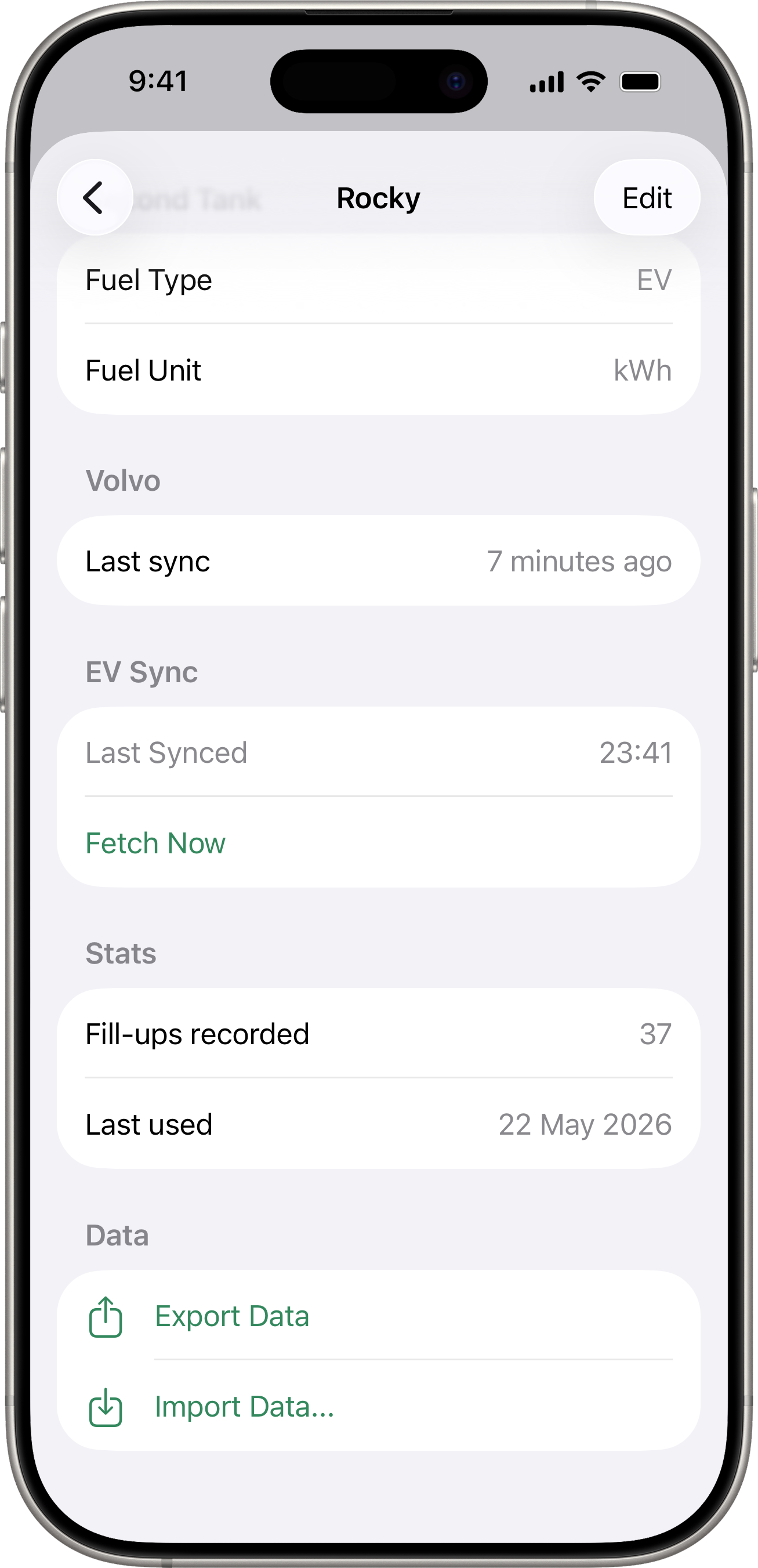
- Go to Settings > Manage Vehicles.
- Tap the vehicle you want to export.
- In the vehicle detail screen, scroll to the Data section.
- Tap Export Data.
- Choose where to save or share the file using the iOS share sheet (e.g. save to Files, send via AirDrop, email).
The export creates a .drivestbackup file containing all data for that vehicle: fill-ups, costs, charging sessions, electricity bills, energy snapshots, reminders, photos, and attachments — with GPS coordinates and odometer values when present.
Importing Data
There are two ways to import:
From the vehicle detail screen
- Go to Settings > Manage Vehicles.
- Tap the vehicle you want to import into.
- Scroll to the Data section.
- Tap Import Data… and select a
.drivestbackupfile.
By opening a file
Tap any .drivestbackup file on your device (e.g. from the Files app or an email attachment). Drivest will open and show an import preview.
Import Preview
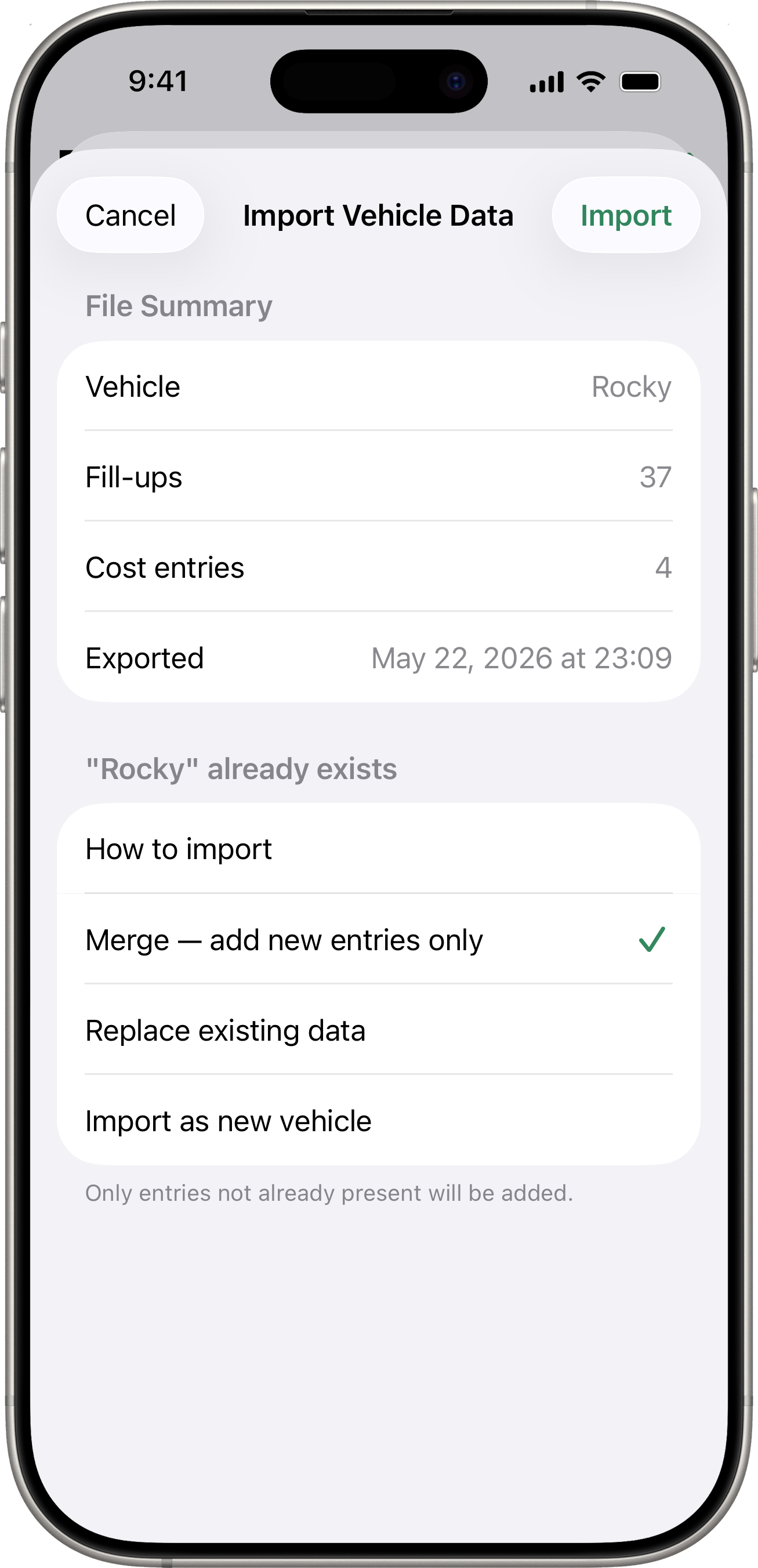
Before importing, the app shows a preview of the data in the file and lets you choose an import strategy:
- Merge — adds the imported data alongside your existing records. Duplicate entries are skipped.
- Replace — replaces the vehicle’s existing data with the imported data.
Review the preview carefully before confirming.
What’s Included in a Backup
- Vehicle information (name, make, model, VIN, settings, battery capacity for EVs)
- All fill-up records with photos and GPS coordinates (when captured)
- All cost entries with photos, file attachments, odometer, and GPS coordinates (new in 1.2)
- All charging sessions with photos, odometer, and GPS coordinates
- All electricity bills
- Reminders
- Energy snapshots (odometer + battery state of charge + fuel level fetched from connected services, plus the trigger badge — Scheduled / Manual / Failed)
Backwards-compatible imports
The new optional fields added in 1.2 (cost odometer, cost location, charging-session fields, battery capacity) are read as nil from older backups produced by 1.1 — no manual migration is needed, and re-exporting an imported 1.1 backup from 1.2 will round-trip the data cleanly.
What’s Not Included
- App-wide settings (currency, categories, appearance, language preference)
- Connected service credentials (authentication tokens)
- The on-device cache of receipt photos beyond what’s attached to a record
Tips
- Export your data regularly, especially before updating iOS or switching devices.
- Store backups in iCloud Drive or another cloud service for safekeeping.
- You can export and import individual vehicles — there is no “export all” option, so back up each vehicle separately.